Disappointing Failure

A week or so ago, an article appeared in Quanta Magazine that discussed disappointments / failures in the field of mathematics and of mathematicians: How Failure Has Made Mathematics Stronger | Quanta Magazine. It is an insightful interview with D. Calegari, a topologist (a mathematician who studies topology, study of “shapes” and their deformations) who talks about failures, a taboo subject in academia. I highly recommend you to read this interview even if you are not in academia because one can always “learn” better ways to deal with disappointments and failures (which are, you will agree, quite abundant in general). I feel that disappointments arising from the realization that “nobody cares about your work” transcends academia and reading about how others deal with that “successfully” can be insightful and eye-opening. It is also worth one’s time, especially when it is not in the format of a self-help book, or being preached from a high moral ground.

In addition, the introduction of the above interview contains a hyperlink for an essay Calegari had written recently about the importance of failures: Disappointment | Notices of the American Mathematical Society. In this essay, I especially liked his recollection of preparing for IMO, its qualification exam, its result and the aftermath. I feel that sort of analytical storytelling is worth everyone’s time. So have a go at that and we will continue this post shortly after that.

⋯ ⋯

⋯ ⋯ ⋯

⋯ ⋯ ⋯ ⋯

Welcome back!

In the AMS essay, the author (correctly) claims that disappointment takes many forms and gives a (partial) list of how & when it can kick in. That list stuck a chord with me and in the rest of this post I will try to elaborate some of those list items from my own personal history. None of them will be as inspiring as his “IMO phase” but nonetheless, it is high time to list my failures and disappointments somewhere and what better place than my own physics blog, so here I go:

(1) being un- or under-acknowledged in a colleague’s paper or talk: This has “happened a lot” simply because of human nature I guess. As my PhD advisor used to say, “People just do their own thing and ignore what others are doing”. In general, scientists acknowledge others’ work in scientific papers via citations (that is, add a reference to the previously published papers at appropriate places in one’s own paper). But when there’s “competition”, the appropriate places tend to reduce from main text of the paper to a bunch of citations squished together in the introduction to mere footnotes. Specially, the worst culprits are those that stoop to the last method, adding a citation as if on second thought, “Oh! and here are these other authors who did a similar thing before”, when the correct way would be to cite in the main text with the phrase, “Oh! these authors pioneered this method and we have neither a way of improving it nor finding new applications for it!”. Well, I go even beyond these worst culprits by omitting to cite them altogether (& not just in future papers!), because who cares! (Well, this is a bit of an exaggeration but here’s a slightly more real recollection.)

(2) being scooped: I was scooped once within a week of starting to work on a topic. What I had done till then comprised just a couple of pages of the scooping paper and what I had planned to do was only half of it. So I was not that disappointed or disheartened, because that paper did more than what I had planned and the rest was done in the way I would have done. If that paper had appeared a month later, then that would have been quite a real disappointment. Though, it was heartening to know that I have scooped others a couple of times (with no explicit intention, obviously)!

(3) missing out on a job/prize/conference invitation: No for a prize or a conference invitation. But definitely for a job. This was the case of a postdoc job at IISc, Bangalore and the “selection committee” had deemed I was “too old” to be hired for that position even when the IISc people supporting my application told me they “had recommended me highly” to the committee. So yes, that was a great disappointment. And after that a few faculty jobs vanished in a similar fashion, though nobody cared to tell me the exact reason as people from IISc had done. Thus there was much less disappointment in these latter cases, as I started to care less & less!

(4) having a prospective student work with someone else: Well, as hinted above, I’m not a faculty member and even as a postdoc, I have only worked with a few students and never have I thought they “belong” to me. This goes back to my PhD days at the YITP, Stony Brook University (SBU). The YITP had quite an open culture regarding who worked with whom and on what! Obviously, one had an official PhD advisor but one was allowed (even encouraged) to work with other professors, postdocs, students on whatever problems / topics one fancied. No professor seemed possessive of their students. Once when I went to meet my advisor after a gap of 4 months, I remember he did not ask what have I been up to or where have I been all this time! We just talked about our “running” project (which had been on hiatus for the last 4 months). At the end of that discussion, when I told him that I have just finished a paper with others (yes, this paper was completed in such a short time and is one of the few that I am really proud of!), he simply replied, “I thought so!” and that was that. [Though, flipping this scenario around, I had taken (in my second year at SBU) an astronomy course whose professor was “impressed” with my course work and final presentation that he offered to become my advisor if my YITP oral exam didn’t go as planned. So he might have been a little bit disappointed when he lost me as a prospective student.]

(5) having a potential advisor turn me down as a student: Again a no. The first professor I approached became my advisor, both for my Masters at IITKGP and Doctorate at SBU. So nothing more to add here. Though, if my PhD advisor hadn’t agreed, I’d have been very, very disappointed!

(6) having a promising line of attack on a problem fail to pan out: Oh, this has happened countless number of times, as is common when one does research, which is the point of the above articles! Though, one that happened while I was a postdoc at NTU stands out a lot among other “failures”, because that line of attack wasted nearly 6 months of our time. Not just mine, but also my colleague’s. And on top of that I’d seen that line of attack not work in my early PhD days! So it was a double whammy of disappointment as it dawned on me that not only have I wasted others’ time but also that it was preventable because of my “prior experience”!

(7) discovering an error in an amazing proof: This hasn’t happened to me directly as such because I’m not a mathematician. But some things related to the previous point could easily be stated here in the kind of research that I have done.

(8) having a paper go unread or a book go unreviewed: No book to talk about. And no disappointment for my papers going unread because, even as Calegari agrees, nobody cares. So no point in being disappointed about that. I do my work because I like it being done, not because somebody else will notice / read it!

(9) seeing an admired senior colleague behave badly: Not really… Though I’ve seen a few “skirmishes” and I want to believe there was nothing personal about them. Taking the “couldn’t care less” attitude further, I respect their work more than them personally.

(10) realizing that I haven’t lived up to my own standards of behavior: Oh! This has happened a countless number of times. Most of my disappointments are in this category, basically. But there’s not much to elaborate…

(11) discovering that success, when it came, was not all I hoped it would be: Well, as far as academic success is concerned, I haven’t reached (and never will) the pinnacle of being a tenured professor. So I can’t say what “success” would have felt like there and if it would have been what I’d have hoped for or not. Graduating from IITKGP with an institute silver medal did feel like “success”. Getting admitted into SBU did feel like “success”. But after that, “success” has been few and far between. Graduating from SBU didn’t feel like “success” and doing three postdocs after that didn’t feel like “success” either. Many colleagues (and brilliant colleagues at that, better than me in all aspects) whom I have known for the last decade or so not “making it” in academia has not felt like “success” either. To say the least, it has instead felt like a personal failure, a crushing weight on my own self. One such disappointment was shared recently by a colleague here, here & here. You know, sometimes it feels like the world is against you but in this case, it is literally true… well, at least a country of the world!

It is also disappointing that this post will not have a hyperlink at the end.

Distribution of talks!

ISM 2021 Review

The past week saw 6 days of the latest edition of “Indian Strings Meeting” hosted by IIT Roorkee. Well, more like hosted by Aalok Misra with some background support from his ‘tech team’ taking care of Zoom calls and YouTube live streams and Webpage updates. I could not attend the Zcalls because of connection problems (at my end I guess) as audio and/or shared screen would randomly drop so I mostly watched the YT live streams. The latter was quite a barren region with <20 viewers at any given time compared to the former which was bustling with <50 participants (i.e., whenever I could join and see and hear something relevant). I wonder what happened to the ~400 registered participants on the website!

Anyway, enough with the personnel logistics, let’s get on with the real logistics that is most relevant in a conference review. That of how many talks were there and of what kind. I will categorize the talks based on four topics extracted from the six review talks, two more topics for 3d field theories and non-3d field theories and one last ‘miscellaneous’ topic (as expected) to catch all those that do not fit into the aforementioned six topics. I do feel like I should mention a disclaimer here, before we have a look at the table, that this categorization of talks is my personal subjective opinion and not to be taken as that of the speakers or Aalok or ISM’s NOC or anyone else for that matter. If anyone does not agree with this categorization, they are welcome to comment below or write their own post and share it as a comment below. (No guarantee that it will change my opinion but if it does, I will be happy to edit things around here accordingly.) Here goes the full table with raw data mined from here:

Topic Review Talks (60m) Research Talks (30m) Short Presentations (15m) Total Time (h)
(A)dS/CFT + Holography RG1 + EP6 + DG6 = 3 TT1 + KN1 + SA2 + SD2 + RL3 + KS3 = 6 SM6 + AS6 = 2
BMS Symmetry + Flat Space Holography LD2 CK1 + AB2 + MM2 + AB2 + RB4 + AYS5 + PP5 = 7 PP5 + DG6 = 2 5
Black Holes + Information Theory DH3 AM1 + AV2 + OP3 + DS3 + NK4 + AA4 + PR6 + JC6 + JKB6 + RS6 + SP6 = 11 AK1 + AKP2 + SM2 + SK3 + AG4 + HP4 + GB5 + AB5 = 8
Amplitudes + (OTO) Correlators JP6 AK1 + AZ1 + AS3 + AR5 + AM5 + SK6 = 6 SD1 + APS1 + SK2 + TS3 + PH5 + AM6 = 6
3d (S)CFTs AM1 + SG2 + KC2 + SM3 + SJ5 = 5 RRJ1 + NP4 = 2 3
Other Field Theories RG2 + YT3 + CG3 + ZK3 + SD4 + VBS4 + NS4 = 7 DM4
Miscellaneous AM1 + BS3 + SG3 + KR5 + LA5 + NS5 + AM6 = 7 MS3 + MM3 = 2 4
Total: 6 49 23 36¼

Let’s acknowledge that the notation used in the table is self-explanatory: the letters are the initials of the speakers (no effort is put to break the degeneracy of AM’s, et al) and the number denotes the day on which they spoke. I have doubly cross-checked the data on the official webpage and my categorization above for consistency. Normally, I don’t put anything up on my blogs, unless it is quadruply checked but since even the official data is not rigorously vetted, I don’t think I need to exert myself that much in this post. For example, a speaker (Parijat Dey from Uppsala University, Sweden) appears in the detailed list of talks but not in the schedule table, which I guess happened because two speakers cancelled their talks on the fifth day which were then moved to the sixth day! Also, at least one 15m talk appears in the list of 30m talks (or vice-versa) and of course, the big elephant in the room is that Enrico Pajer’s hour-long review talk appears in a 30m timeslot and it was treated as something in-between! So given that the raw data is not too trustworthy, I think the doubly checked table appearing above is more than enough for my purposes here.

I also have some pet peeves about the formatting/styling employed for the “Schedule” webpage linked above. I mean, who in the ‘tech team’ had the ‘brilliant’ idea of sorting the detailed list of talks wrt length of the talks and then further sorting alphabetically (which is also not quite correct) wrt last names of the speakers? This leads to the following bad user experience: when someone clicks a speaker’s name in a particular timeslot of the schedule table, they are catapulted at warp-speeds through the long webpage to the speaker details but now they’re lost (& disoriented) because they don’t see any other speaker details around the timeslot they were just looking at a moment ago! This problem could have been avoided if the speakers were sorted chronologically and not alphabetically (basically, focus on talks and not speakers). Also, that awfully long webpage could have been shortened by light-years if a tabbed interface were used for the six days, with each day’s tab showing the chronological details of the talks. I also find the insistence on “speakers of” review/research talks in the headings for the corresponding sections but not for the short presentations pretty hilarious (see the screenshot below). As if the people giving those short presentations are not worthy of being even identified with a common noun. Talk about inequalities prevalent in academia! This problem also would not have risen if the talks were chronologically listed. A lot fixed with a simple change in one’s viewpoint.

ISM 2021 Speakers?

Anyway, enough of my rant about webpage development (I mean I could have done a better job myself of formatting/organizing that page… Come on, man! Move on! Your rant just spilled on to the next para… and I will have to start a new clean para again!).

That table above presents quite a boring view so let’s look at a colourful chart based on it instead:

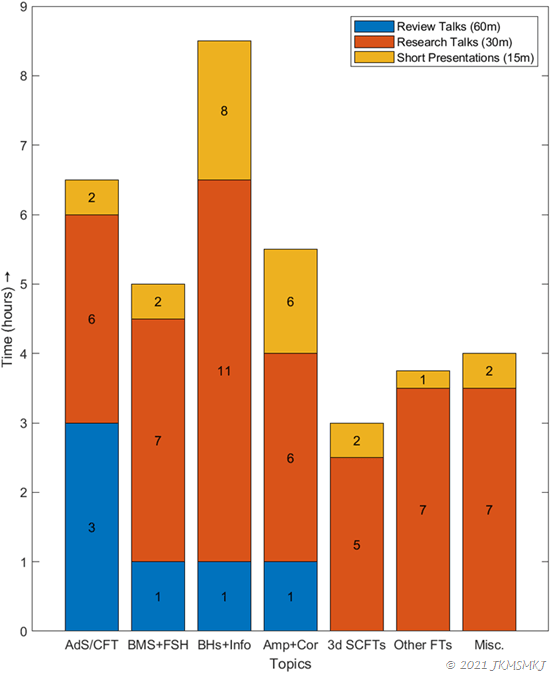
Stacked Bar Chart 1

We see that the topic of black holes and related stuff like entanglement entropy, information paradox was extremely popular taking up more than eight hours, i.e., more than a day in a six-days-long conference. The three other main topics in this conference were “(A)dS/CFT & holography”, “S-matrices, scattering amplitudes & correlators (incl. OTOCs)”, and “BMS symmetry & flat space holography”, which took up roughly a day each. The talks on field theories in various dimensions took up another day with most people focussing on 3d (super)conformal field theories but some quite interesting talks on 2d and 4d theories too. Disappointingly, my personal favourite “5d SCFTs” barely got mentioned. Finally, the miscellany of talks included a talk on string phenomenology, a couple on constructing actions for Weyl supergravity multiplets, and a few on mathematical aspects like new Lie algebras, machine learning, etc. Before we move on, let us also see the above data split day-wise. Can you spot the only topic which was talked about every single day? The answer won’t surprise you!

Stacked Bar Chart 2

Now, I guess I should lay down my own personal views on ISM 2021. First (confession), I didn’t watch all the talks but most of them to be able to have some motivation to write this post. Second, the constant shifts of the schedule by at least 15m (and going up to 45m as the day progressed) really twisted my holography (reference to DG6’s talk if you don’t get my drift). Third, I was looking forward to some talks because of their titles, some because of their speakers. Both of these types didn’t disappoint. Others were hits and misses. Fourth, the constant bug in almost all of the talks was that typical questioner/commenter who hadn’t properly formulated (or even envisioned) the question before opening his (let’s be real, it’s definitely ‘his’ not ‘her’!) mouth, leading to mostly vague questions or tautological statements disguised as comments. That led in turn to more haw-ing, hmm-ing, “I mean(t)”’s, “you know, like”’s, “the the, so that thing”’s, “the usual thing, you know”’s, “so so, that’s what… the the, what I meant was”’s, etc. You get the idea why it bugged me, right? I wish Indian institutes had “graduate seminar courses” like I had at Stony Brook where professors actually gave you proper feedback on your talks. In addition, listening to fellow students in that ‘classroom’ setting made you aware of what to do and what not to do during talks, both yours and others. Some of the speakers & listeners of this conference could have definitely used some exposure to such a course. Fifth, I didn’t listen to most of the discussion sessions, except one where the bugging became quite unbearable and I just had to leave. I had better things to do like watching “Have I Got a Bit More News for You?” or having dinner or anything else.

Finally, we have to discuss what does all this mean. As in, what is the string theory research landscape in India like? Where is this research program headed in India? What are the differences compared to similar programs in other countries? And so on… I couldn’t care less about answering such boring questions. Indirect answers (or sketches thereof) to some of these questions are already available in the previous but one para. Even then, one ‘answer’ that just screams out of the data and charts above is: The ST research landscape is mostly covered by two (composite) peaks, those of black holes and (any kind of) holography. The two peaks from which I am as far away as possible given the plain areas of my research of the past decade. Let’s end this geological metaphor and get back on track of the un-punny sentences. My research falls majorly in the two minor categories of 3d (S)CFTs and other field theories (mostly dealing with 5d theories, as mentioned above) with some minor overlap with the major category of AdS/CFT & holography. As we all know, 2021 was not a good year for many reasons for many people, and I can now add this one revelation to my personal list of such reasons. This might urge one to ask so would I be moving towards the peaks from the plains? Oh, Hell No! I am quite happy with the plains I prowl on.

Wait, there’s one last thing to talk about: Discussion session on gender imbalance in STEM. I guess one of the reasons we have this problem is we talk about it at the end. Ok, enough with the jokes. This was a serious discussion… I learnt a lot with some precise language and data fleshing out the vague ideas I have had about the problem. The panelists in this discussion session represented ‘all walks of academic life’ who shared their experiences, talked about steps taken, being taken, steps in the pipeline, etc. Even general ideas encompassing treatment of minorities and amendment of systemic procedures to be more inclusive got an airing out. I encourage everyone to listen to this session, even re-listen, so that things (start to) change for the better.

Happy New Year! 🎉